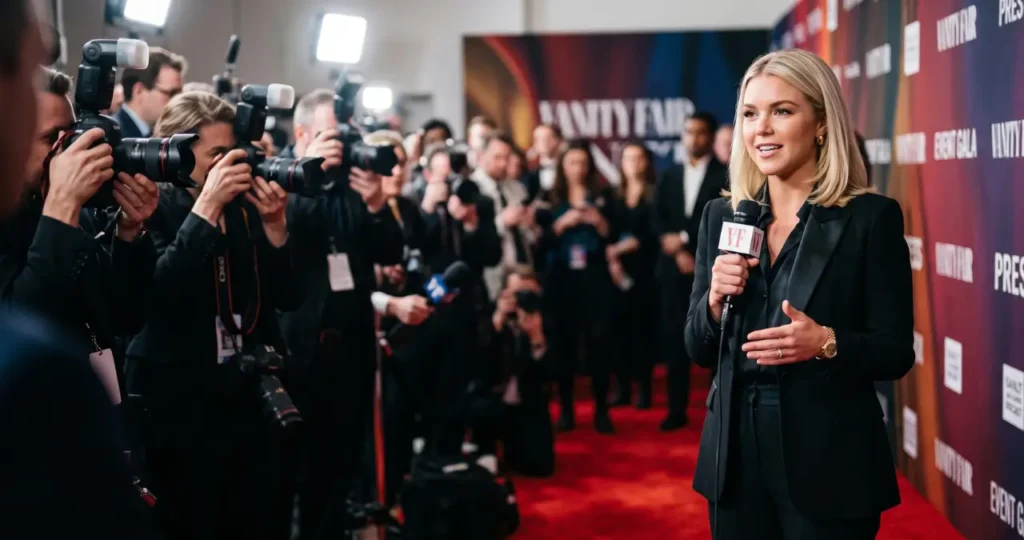

The Vanity Fair Karoline Leavitt photo controversy erupted in mid-December 2025, after the magazine published an unusually close, unretouched portrait of the White House press secretary alongside a bombshell profile of Chief of Staff Susie Wiles. The image spread quickly on social media, drawing millions of views and sparking a heated debate about political photography, image control, and press access.
This article breaks down what actually happened, who took the photos, why Leavitt’s portrait became the most talked-about image in the series, and how the White House responded.
What Happened With the Vanity Fair Karoline Leavitt Photos?
Vanity Fair published a two-part profile of Susie Wiles in mid-December 2025, written by journalist Chris Whipple, built on eleven on-the-record interviews conducted over roughly a year. The story came with a set of extreme close-up portraits of top Trump administration officials, and the Karoline Leavitt image quickly became the centerpiece of online reaction.
The photos accompanied the written piece rather than standing alone. But once the images hit Vanity Fair’s Instagram account, they took on a life of their own, separate from the text that inspired them.
Leavitt’s portrait, in particular, showed skin texture, makeup, and other close-range details rarely seen in official political photography. Within hours it had generated tens of thousands of views and thousands of comments, far outpacing engagement on the other portraits in the series.
Who Took the Karoline Leavitt Vanity Fair Portrait?
The photographer behind the image is Christopher Anderson, a 55-year-old photojournalist known for his intense, close-range portrait style. He has contributed to the New York Times, the New York Times Magazine, Esquire, and the Wall Street Journal, and has won a Robert Capa Gold Medal for earlier photojournalism work.
Anderson photographed several senior officials during the same White House shoot, including Susie Wiles, Vice President JD Vance, Secretary of State Marco Rubio, Deputy Chief of Staff for Policy Stephen Miller, Presidential Personnel Office Director Dan Scavino, and Deputy Chief of Staff James Blair. Leavitt’s image drew the most attention of the group.
Anderson described his approach as a deliberate stylistic choice, not an attempt to embarrass anyone. He has used similarly tight, unforgiving close-ups throughout his career, across administrations and political parties, aiming to move past the staged presentation that usually surrounds powerful public figures.
Anderson’s Explanation of His Style
Anderson told reporters that his goal was to cut through what he called the theater of politics rather than flatter or humiliate his subjects. He argued that treating politicians like celebrities, by smoothing every imperfection, misrepresents the nature of political photojournalism.
He also pointed out that traditional, more conventional portraits from the same shoot went largely unnoticed. It was the extreme close-ups specifically that triggered the reaction, not his overall body of work from that day.
Why Did the Karoline Leavitt Vanity Fair Photo Go Viral?
The image went viral because of its unusually tight framing, which revealed fine details of skin and makeup that official portraits almost never show. Viewers online zeroed in on marks near her lips that many speculated were signs of cosmetic injections, and the discussion spread quickly across Instagram, X, and other platforms.
Anderson later told the Washington Post that the marks appeared to be injection sites, though he did not claim expertise in cosmetic procedures. This detail became the focal point of much of the online commentary, overshadowing broader discussion of the accompanying Wiles profile.
The Lip Filler Speculation
It’s worth being precise here: the photographer offered an observation, not a medical or confirmed fact, and Leavitt has not publicly addressed the specific speculation about cosmetic procedures. What is confirmed is that the image showed visible texture and marks that commenters interpreted in various ways, and that this speculation, rather than the underlying journalism, dominated a large share of the online conversation.
This is a useful distinction for anyone researching the topic. A lot of the viral discussion conflated an unverified interpretation of a photo with an established fact, which is not the same thing.
How Did the White House Respond to Vanity Fair?
The White House response was sharply critical, with officials arguing the photos were manipulated or unfairly framed to embarrass staff. White House spokeswoman Taylor Rogers said it was clear Vanity Fair had intentionally photographed Leavitt and other staffers in unflattering ways and had edited the images to demean them.
Rogers also defended Leavitt directly, calling her one of the most impressive people in politics and praising her work as press secretary. Secretary of State Marco Rubio went further, describing the photos as deliberately manipulated.
Susie Wiles, whose interviews formed the backbone of the written profile, called the overall piece a disingenuously framed hit piece, arguing that important context had been left out.
Karoline Leavitt’s Own Reaction
Leavitt addressed the story publicly on Fox News, calling the broader Vanity Fair piece an attempt at fake news and criticizing it for what she described as bias by omission. She also said comments attributed to Wiles in the piece had been taken wildly out of context, though that criticism was aimed primarily at the written profile rather than the photography itself.
On the same day the piece published, Leavitt posted her own behind-the-scenes photos on Instagram, showing herself preparing for a live television interview outside the White House. Many read this as an indirect response to the viral portrait, though she did not explicitly frame it that way in her caption. Reaction to that post was mixed, with some commenters questioning why she chose to share it.
Marco Rubio and Susie Wiles React
Beyond Leavitt, other officials pushed back hard. Rubio’s manipulation claim and Wiles’ hit piece characterization reflect a broader administration strategy of contesting both the images and the written content together, rather than treating them as separate controversies.
Vanity Fair and the photographer maintained the images were unretouched and consistent with standard photojournalism practice, creating a direct dispute between the magazine’s account and the administration’s characterization of events.
What Was the Vanity Fair Profile Actually About?
The written centerpiece of the story was not the photos at all. It was a candid, on-the-record profile of Susie Wiles based on eleven interviews, in which she offered blunt characterizations of people inside Trump’s orbit, including the president himself.
Wiles reportedly described Trump as having an alcoholic’s personality, a phrase that generated significant coverage on its own, separate from the photo controversy. She was also quoted describing Vice President JD Vance as having become a conspiracy theorist who backed Trump more out of political calculation than genuine belief.
Chris Whipple, the journalist who conducted the interviews, later said everyone involved understood what they had signed up for, and that Wiles was fully on board with the project from the start. Trump himself reportedly brushed off the alcoholic’s personality remark rather than treating it as a major insult.
Susie Wiles’ Comments About Trump
These quotes from Wiles drew as much, or more, national attention than the Leavitt photo itself in the days immediately following publication. Cable news coverage and White House pushback focused heavily on the Trump and Vance characterizations, showing that the viral photo was only one piece of a much larger story.
Did the Epstein Files Vote Disrupt the Photo Shoot?
Yes. Anderson later revealed that his carefully planned shoot day was thrown off when the Cabinet was suddenly summoned to the Situation Room amid a scramble to pressure a lawmaker over a vote related to the Epstein files. That disruption reportedly changed the pacing and access he had for the rest of the session.
This detail, disclosed after the initial controversy had already peaked, adds useful context. The chaotic conditions inside the West Wing that day may partly explain why some portraits, including Leavitt’s, ended up feeling more raw or unguarded than officials expected.
Vanity Fair’s Style vs. Traditional Political Portraiture
Most official White House photography is tightly controlled, using flattering angles, professional retouching, and staged settings designed to project authority and polish. Vanity Fair’s approach with Anderson inverted that entirely, prioritizing unfiltered detail over image management.
This is a genuinely useful comparison for understanding why the reaction was so intense. Readers are used to seeing political figures through a highly managed visual filter, whether in official portraits or campaign photography. Anderson’s extreme close-ups broke that pattern deliberately, and the surprise of seeing a familiar public figure without any of the usual visual polish is arguably what drove the viral spread more than any single detail in the image itself.
That gap between expectation and presentation is a pattern worth watching. Similar close-up styles have generated backlash before when applied to public figures across the political spectrum, suggesting this is less about one administration and more about how uncomfortable unfiltered imagery makes almost any subject in the age of retouched, algorithm-friendly photos.
FAQ
What is the Vanity Fair Karoline Leavitt controversy about?
It centers on an extreme close-up portrait of the White House press secretary, published alongside a Vanity Fair profile of Susie Wiles in December 2025, that went viral for its unusually unfiltered detail.
Who photographed Karoline Leavitt for Vanity Fair?
Christopher Anderson, a photojournalist known for close-range political portraiture, took the image as part of a wider shoot with several senior Trump administration officials.
Why did people think the photo showed lip filler injection sites?
The photographer told the Washington Post the marks appeared to be injection sites, which fueled widespread online speculation. This remains an observation from the photographer rather than a confirmed medical fact.
Did Karoline Leavitt respond to the Vanity Fair photos?
Leavitt called the broader Vanity Fair piece an attempt at fake news and criticized it for bias by omission. She also posted her own behind-the-scenes Instagram photos the same day the story published.
What did Susie Wiles say about Trump in the Vanity Fair profile?
Wiles reportedly described Trump as having an alcoholic’s personality, one of several candid remarks that generated significant coverage independent of the photo controversy.
How did the White House officially respond?
White House spokeswoman Taylor Rogers said the images were intentionally taken and edited to demean staff. Marco Rubio called the photos deliberately manipulated, and Wiles called the profile a disingenuously framed hit piece.
Were the Vanity Fair photos retouched?
No. Photographer Christopher Anderson stated the images were not retouched, arguing that journalistic photography of politicians should not receive the same treatment as celebrity photography.
Did anything disrupt the Vanity Fair photo shoot?
Yes. Anderson later said the shoot was interrupted when the Cabinet was called to the Situation Room during a scramble related to a vote on the Epstein files, which affected the rest of his access that day.
Who else was photographed in the same Vanity Fair series?
The series included Susie Wiles, JD Vance, Marco Rubio, Stephen Miller, Dan Scavino, James Blair, and Karoline Leavitt, all photographed during the same White House session.
Is the Vanity Fair Karoline Leavitt photo still available to view?
Yes, the images remain part of Vanity Fair’s published profile and were also shared on the magazine’s Instagram account, where they generated the bulk of the viral engagement.