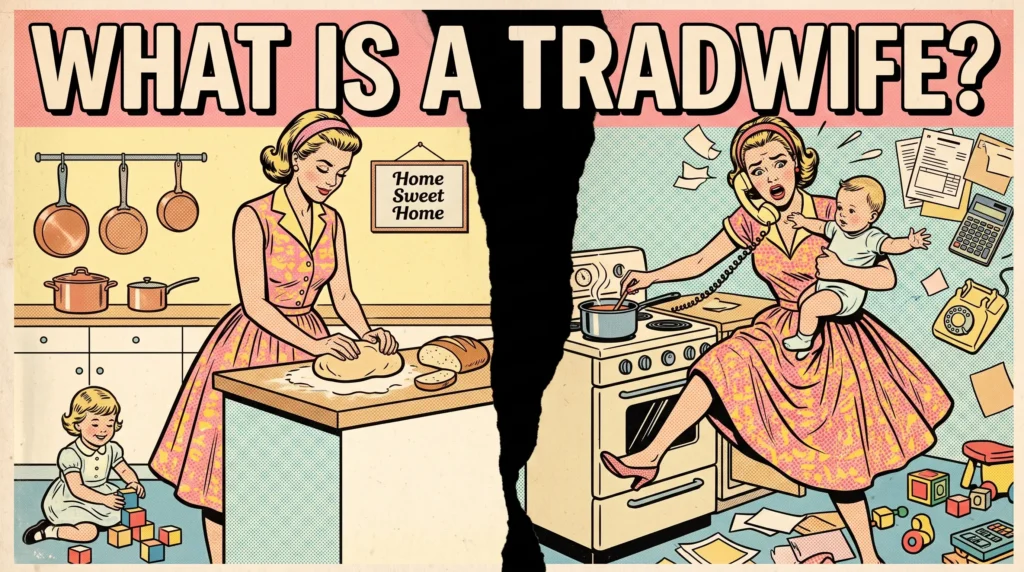

A tradwife, short for “traditional wife,” is a woman who embraces conventional gender roles, prioritizing homemaking and child-rearing while a male partner typically works and provides financially. The term describes both a personal lifestyle choice and, more visibly, an online content genre built around curated domestic life. If you’ve asked what is a tradwife because you keep seeing pastel kitchens and prairie dresses on your feed, you’re looking at a specific internet subculture, not just a description of stay-at-home motherhood.
The word carries more weight than a simple lifestyle label. It’s tied to ongoing debates about feminism, economics, and politics, and even researchers disagree on where its boundaries sit.
What Is a Tradwife, Exactly?
A tradwife is a woman, almost always married, who publicly embraces traditional gender roles: managing the household, raising children, and deferring to her husband as the primary decision-maker and earner. The term applies both to women living this way privately and, far more commonly in search results, to social media creators who document it as content.
Researchers studying the phenomenon describe it as a “postfeminist” figure — someone presenting traditional domesticity as an empowered personal choice rather than an imposed obligation. That framing is part of what makes the term contested. Some tradwives explicitly reject feminism; others describe their lifestyle as an exercise of the same freedom of choice that feminism fought to secure.
It’s also worth separating the word from the lifestyle itself. Plenty of women manage households and support working husbands without ever using the label or engaging with tradwife content online. The term specifically points to a self-aware identity and, often, a public-facing aesthic built around it.
Where Did the Term Come From?
“Tradwife” is a portmanteau of “traditional” and “wife,” and it emerged as an internet subculture label in the 2010s before going viral in the early 2020s. British influencer Alena Kate Pettitt is widely credited as one of the earliest and most recognizable figures to use the term to describe herself.
The trend accelerated during COVID-19 lockdowns, when people spent more time online and domestic content, including the related “cottagecore” aesthetic, found a wider audience. Algorithmic recommendation systems reportedly played a real role here: viewers interested in cottagecore’s soft, nostalgic visuals were often fed tradwife content next, since the two genres share a similar look even though tradwife content adds an explicit ideological layer about gender hierarchy that cottagecore doesn’t require.
What Does Tradwife Content Look Like Online?
Tradwife content typically features highly produced videos of cooking from scratch, homesteading tasks, and idealized family scenes, often styled with 1950s or homesteading aesthetics. Common visual markers include vintage dresses or aprons, pastel kitchens, and narration about serving or submitting to a husband.
The content is deliberately aspirational rather than documentary. Cooking elaborate meals, canning produce, or hand-sewing clothing gets filmed and edited like a lifestyle magazine spread, not like an ordinary Tuesday. That gap between the polished footage and the actual labor involved is one of the most consistent points critics raise, since the videos rarely show exhaustion, conflict, or the financial reality behind the lifestyle.
Ironically, producing this content is itself a job. Successful tradwife creators spend hours filming, editing, and posting, and many earn substantial income from brand deals and platform payouts, which sits uneasily next to a message centered on stepping back from paid work.
What Is a Tradwife Versus a Stay-at-Home Mom?
A stay-at-home mom simply describes a woman’s employment status: she cares for children full-time instead of working outside the home, without any inherent ideology attached. A tradwife, by contrast, layers an explicit belief system on top of that arrangement, one centered on gender hierarchy, wifely submission, and often a critique of modern feminism.
Plenty of stay-at-home mothers would never identify with the tradwife label, and some tradwife-adjacent creators have publicly rejected the term even while posting similar content. Nara Smith, one of the most recognizable creators associated with the aesthetic, has pushed back on being called a tradwife despite content that closely matches the genre’s visual style.
The distinction matters because “stay-at-home mom” describes a practical arrangement millions of families choose for all kinds of reasons, while “tradwife” describes a specific, publicly performed identity with political and cultural baggage attached to it.
Why Is the Tradwife Trend Growing in 2026?
The tradwife trend has continued expanding in 2026, drawing in a notably younger cohort of teenage and early-twenties influencers alongside the established creators who built the genre. Economic and social pressure appears to be a major driver: a 2026 YouGov survey found more than two-thirds of single people reported rarely going on dates, and a tightening entry-level job market has made stability harder to find for young adults.
Media professor Catherine Rottenberg of Goldsmiths, University of London, has suggested the movement offers young women a sense of purpose and stability during genuinely uncertain economic conditions. That reading doesn’t require agreeing the lifestyle is realistic or widely achievable; it simply explains part of the trend’s emotional pull.
Pop culture has amplified this further. Caro Claire Burke’s 2026 novel “Yesteryear,” about a tradwife balancing a business, five children, and a struggling Utah farm, spent months on bestseller lists and is being adapted into a film starring Anne Hathaway, which shows how far the theme has moved beyond social media into mainstream entertainment.
Who Are the Most Recognizable Tradwife Influencers?
Hannah Neeleman, known online as “Ballerina Farm,” and Nara Smith are among the most-followed creators associated with the tradwife aesthetic, each with millions of followers across TikTok and Instagram. Neeleman documents farm and family life in Utah, while Smith is known for elaborate from-scratch cooking videos, though she has resisted the tradwife label herself.
A newer wave of younger influencers has emerged more recently, including creators like Ahavat Ava, a 20-year-old whose content blends traditional homemaking themes with more overtly submissive framing toward her husband. This generational shift, from established creators in their late twenties and thirties to teenagers and early-twenties influencers, is one of the more notable developments in the space this year.
Is the Tradwife Movement Political?
Much tradwife content presents itself as apolitical lifestyle content, but researchers and journalists have documented consistent overlap between the movement and conservative or far-right ideology. Academic analysis published in 2026 argues the trend functions as a vehicle for promoting alt-right and highly conservative values through an individualized, aesthetically appealing lifestyle framework.
Not every tradwife or tradwife-adjacent creator engages with explicit politics, and researchers themselves note real disagreement about where the boundaries of the label sit. Some participants focus purely on homemaking content without political commentary, while others openly connect their lifestyle to critiques of feminism, LGBTQ+ rights, or mainstream gender politics. Coverage from outlets like the Boston Globe has also linked the broader “tradwife summer” cultural moment to a wider ecosystem of conservative women’s media and commentary.
What Do Critics Say About Tradwives?
Critics argue the tradwife movement romanticizes financial dependence and reinforces gender roles that took decades of feminist progress to dismantle. Academic researchers have specifically noted that the trend tends to reflect white, upper-middle-class, and colonial-nostalgic understandings of domesticity rather than a universally accessible lifestyle.
There’s also a documented labor-reality critique. In the United States, 57.3 percent of working-age women were employed in 2025, compared with 35.7 percent in 1955, according to Bureau of Labor Statistics data — meaning the “traditional” era tradwife content evokes doesn’t reflect how most American women actually live now, or arguably ever fully did. Former participants and investigative reporting have also described curated tradwife portrayals masking real exhaustion and household inequality behind the scenes.
Is Being a Tradwife a Feminist Choice or a Step Backward?
This is genuinely contested, and reasonable people land in different places. Some defenders frame it through “choice feminism,” arguing that a woman freely choosing domesticity is itself an exercise of the autonomy feminism secured, regardless of what she chooses. Critics counter that “choice feminism” doesn’t hold up well against a lifestyle modeled on a 1950s framework that offered most women little actual agency to begin with.
There’s also an internal contradiction researchers have pointed out directly: successful tradwife influencing is, itself, a job that generates independent income, which sits at odds with a lifestyle built around financial dependence on a husband. Whether that’s a meaningful contradiction or simply how modern content creation works is, again, a matter of interpretation rather than settled fact.
FAQ
What is a tradwife in simple terms?
A tradwife is a married woman who embraces traditional gender roles, prioritizing homemaking and childcare while typically deferring to her husband as the primary earner and decision-maker, often documenting that life on social media.
Is “tradwife” the same as “housewife”?
Not exactly. “Housewife” simply describes a woman’s role managing a household, while “tradwife” adds an explicit ideological stance about gender hierarchy and often includes a public, content-driven identity around it.
Who started the tradwife trend?
British influencer Alena Kate Pettitt is widely credited as one of the earliest people to publicly use the “trad wife” label for herself, helping popularize the term in the 2010s before it went viral in the early 2020s.
Is Nara Smith a tradwife?
Nara Smith’s content, elaborate from-scratch cooking and homemaking, closely matches the tradwife aesthetic, but she has publicly said she doesn’t identify with the label herself.
Is the tradwife movement connected to far-right politics?
Research published in 2026 has documented meaningful overlap between tradwife content and conservative or far-right messaging, though the connection varies significantly by creator, and not all tradwife content is explicitly political.
Why is the tradwife trend so popular right now?
Economic uncertainty, a tougher job market, and difficulty finding stable relationships appear to be contributing factors, with some researchers suggesting the lifestyle offers a sense of purpose during unstable times.
Can a tradwife also have a career?
Traditionally, no, since the identity centers on stepping back from paid work. In practice, many prominent tradwife influencers earn significant income from content creation, which critics note is a notable contradiction within the movement.
Is being a tradwife a feminist choice?
It depends who you ask. Supporters frame it as exercising the freedom to choose domesticity; critics argue the framework itself, rooted in 1950s-style gender hierarchy, undercuts the idea that it’s a fully free choice.
Are all tradwife influencers religious?
Not all, but many tradwife creators do incorporate Christian or conservative religious framing into their content, particularly around marriage, submission, and family roles, though this varies by creator.
Is the tradwife trend growing or fading in 2026?
It’s continuing to grow, with a notable rise in teenage and early-twenties creators joining established influencers, alongside mainstream cultural attention through bestselling novels and an upcoming film adaptation.