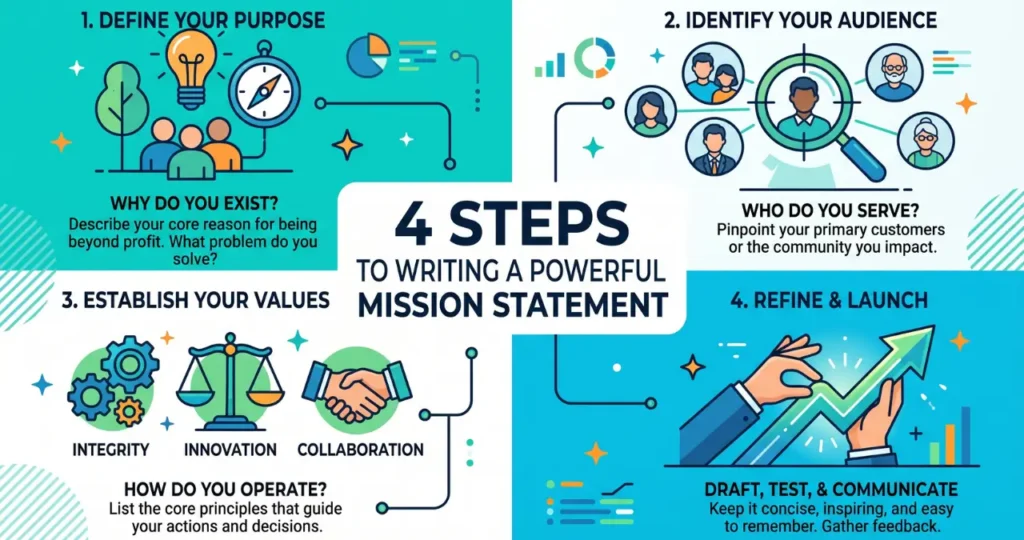

A strong mission statement explains why an organization exists, whom it serves, and what it aims to do. Learning how to write a mission statement helps businesses, nonprofits, teams, and even individuals turn a broad purpose into a clear statement that guides decisions.
The best mission statements are not necessarily long or clever. They are specific enough to communicate purpose, simple enough to remember, and meaningful enough to influence everyday choices.
This guide explains how to write a mission statement step by step, what makes one effective, how a mission differs from a vision, and how to improve a weak draft.
What Is a Mission Statement?
A mission statement is a concise description of an organization’s fundamental purpose. It generally communicates what the organization does, who it serves, and the value it aims to provide.
A mission statement can help employees understand priorities and give customers, partners, or other stakeholders a clearer picture of what the organization stands for.
For example, a generic statement such as “We want to be the best company in our industry” says little about the organization’s actual purpose. A stronger statement would explain the specific people it serves and the value it intends to create.
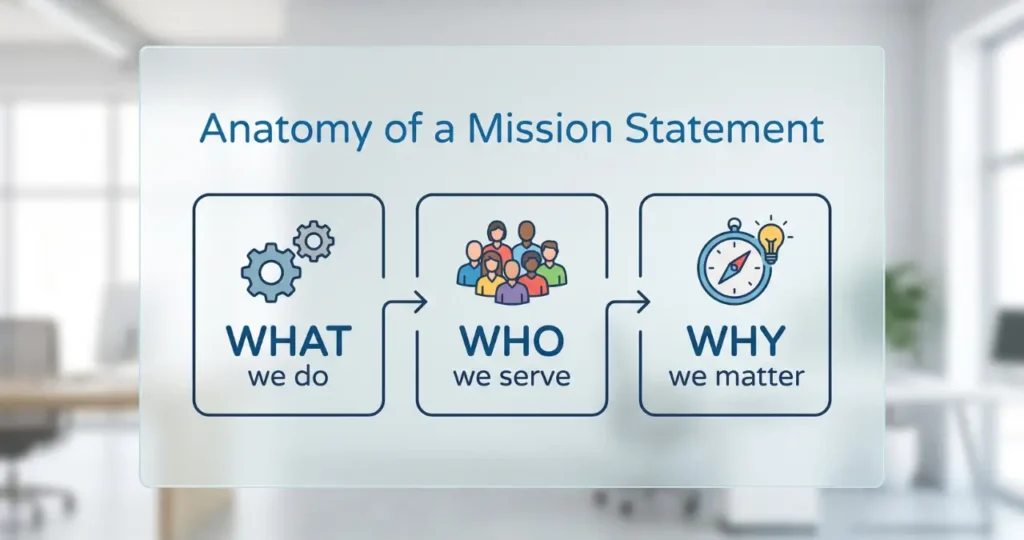
A useful mission statement usually answers three questions:
- What do we do?
- Who do we serve?
- Why does our work matter?
Some organizations also include how they create that value or the principles that shape their work.
Mission Statement vs. Vision Statement
A mission statement describes an organization’s current purpose and work, while a vision statement describes the future it hopes to create.
Think of the difference this way:
| Mission | Vision |
|---|---|
| What we do now | What future we want |
| Who we serve | What we hope to achieve |
| Why our work exists | What success ultimately looks like |
| Guides current decisions | Provides long-term direction |
For example, a company might have a mission focused on making educational resources affordable and accessible, while its vision describes a future where everyone can access high-quality learning regardless of location or income.
Understanding this distinction makes it easier to write a mission statement that focuses on purpose rather than future aspirations alone.
How to Write a Mission Statement Step by Step
The easiest way to write a mission statement is to begin with the organization’s purpose rather than trying to create a polished sentence immediately. Answer a few practical questions first, then turn the answers into one concise statement.
1. Identify Why the Organization Exists
Start by defining the fundamental reason the organization exists beyond making money.
Ask:
- What problem are we trying to solve?
- What need do we address?
- Why did this organization need to exist?
- What would customers or communities lose if we disappeared?
This question often reveals the core of the mission.
For instance, a tutoring business might initially say, “We provide online tutoring.” That describes an activity, but it does not fully explain the purpose.
A deeper answer might be: “We help students understand difficult subjects through affordable, accessible tutoring.”
The second version gives the activity a clear purpose.
2. Define Who You Serve
A mission becomes more useful when it identifies its intended audience.
Your audience could be:
- Small business owners
- University students
- Local families
- Healthcare professionals
- Independent creators
- Nonprofit organizations
- Enterprise customers
- A specific community
You do not always need to name a narrow demographic. However, your wording should make it reasonably clear who benefits from your work.
Instead of saying:
“We provide technology solutions.”
Consider:
“We help small businesses simplify everyday operations with accessible technology.”
The second statement immediately establishes a customer and a benefit.
3. Explain What You Actually Do
Describe the organization’s main activity in plain language.
Avoid trying to list every product, service, department, or business function. A mission statement should communicate the central activity rather than becoming a company catalog.
For example:
- “We design affordable home products.”
- “We connect local businesses with skilled workers.”
- “We provide accessible financial education.”
- “We develop software that helps teams manage projects.”
Use a verb that clearly describes the organization’s role.
4. Identify the Value You Create
The next step is to explain why your work matters.
Ask what changes for customers or communities because your organization exists.
The value might involve:
- Saving time
- Improving access
- Reducing costs
- Increasing safety
- Solving a specific problem
- Providing education
- Creating convenience
- Supporting economic opportunity
- Improving quality of life
This step is especially important because many weak mission statements only describe what an organization sells.
A bakery does not merely “sell bread.” Its broader value might involve providing fresh, affordable food to a local community. The exact wording should reflect the bakery’s genuine purpose rather than adding an impressive-sounding idea that does not influence its work.
5. Combine the Core Ideas
Once you have your answers, combine them into a rough sentence.
A simple framework is:
We [what we do] for [who we serve] so they can [benefit or outcome].
For example:
“We provide affordable online tutoring for students so they can build the skills and confidence needed to succeed in school.”
This is not the only formula for how to write a mission statement, but it provides a useful starting point.
You can then remove unnecessary words and make the statement more distinctive.
6. Make It Specific
Specificity separates a meaningful mission from a generic corporate slogan.
Compare:
Weak:
“We strive to deliver innovative solutions and exceptional experiences.”
Stronger:
“We help independent retailers manage inventory and orders through simple, affordable software.”
The first statement could describe thousands of organizations. The second gives the reader a clearer understanding of the organization’s purpose.
Specificity does not mean adding technical details. It means choosing words that communicate the organization’s actual role.
7. Keep It Concise
A mission statement should communicate its central idea without requiring a long explanation.
There is no universal official word limit for mission statements. Some organizations use a single sentence, while others use a short paragraph. The right length depends on how much context is genuinely necessary.
As a practical test, ask someone unfamiliar with the organization to read the statement once and explain what the organization does. If they cannot identify the basic purpose, simplify it.
A useful mission statement should work on its own without requiring a page of explanation.
How to Write a Mission Statement for a Business
For a business, the mission statement should connect the company’s activities with the value it provides to customers. It should describe a genuine purpose rather than simply repeating marketing language.
When learning how to write a mission statement for a business, focus on four areas:
- Customer: Who does the business serve?
- Problem: What need does it address?
- Offering: What does it provide?
- Value: What meaningful benefit does it create?
For example, imagine a fictional company called BrightPath Learning:
“We make high-quality learning resources affordable and accessible so students can study with greater confidence.”
The statement identifies the company’s work, its audience, and the value it wants to provide.
Notice that it does not say the company is “number one,” “world-class,” or “revolutionary.” Those claims do not explain its purpose.
How to Write a Mission Statement for a Nonprofit
A nonprofit mission should clearly communicate the issue it addresses, the people or communities it serves, and the change it seeks to create through its current work.
For example:
“We provide free digital literacy training to underserved adults so they can access education, employment, and essential online services.”
This makes the beneficiary and activity clear.
Nonprofits should avoid making their mission so broad that almost any activity could fit beneath it. A focused mission can help organizations evaluate whether a new program actually supports their purpose.
What Makes a Good Mission Statement?
A good mission statement is clear, specific, relevant, credible, and useful for decision-making. It should describe a purpose the organization can actually support through its actions.
Use these five tests to evaluate your draft:
Clarity
Can someone understand the statement without industry jargon?
Replace complicated terminology with ordinary language wherever possible.
Specificity
Does the statement distinguish the organization from similar organizations?
If a competitor could copy your mission statement without changing a word, it may be too generic.
Relevance
Does the statement reflect what the organization actually does today?
A mission should not describe an activity the organization has abandoned or a future ambition it has not yet pursued.
Credibility
Can the organization realistically support the promise it makes?
A small local service provider does not need to claim that it will “transform the world.” A credible statement can be more persuasive than an exaggerated one.
Usefulness
Can the mission help leaders and employees make decisions?
This is one of the most overlooked tests.
Suppose a company’s mission emphasizes making professional education affordable. When considering a new premium product, leaders can ask whether that product supports the mission. The statement becomes a decision-making tool rather than decorative text on an About page.
Common Mission Statement Mistakes
Many mission statements fail because they prioritize impressive wording over useful information. Avoid vague promises, unnecessary jargon, excessive length, and claims that do not reflect the organization’s real work.
Using Generic Corporate Language
Words such as “innovative,” “excellence,” “world-class,” and “solutions” are not automatically bad, but they often add little meaning when used without specifics.
Instead of saying:
“We deliver innovative solutions with excellence.”
Explain what you solve and for whom.
Trying to Include Everything
A mission statement should not become a list of every product and strategic objective.
If the organization offers ten services, identify the common purpose connecting them rather than listing all ten.
Confusing Mission With Vision
Statements about becoming a market leader, changing the future, or reaching a distant goal often belong in a vision statement or strategic plan.
The mission should remain grounded in the organization’s current purpose.
Writing for Executives Instead of Readers
Mission statements often become difficult to understand because they contain internal terminology.
Write for an intelligent reader who knows nothing about the organization’s internal structure.
Making the Statement Too Broad
“Making the world better” may sound positive, but it gives employees little practical guidance.
A more focused statement explains the specific contribution the organization makes.
A Simple Mission Statement Formula
A practical formula can help you create the first draft, but treat it as a starting point rather than a rule.
We [action] [what you provide] to/for [audience] so that [benefit or outcome].
For example:
“We connect local businesses with reliable digital tools so they can serve customers more efficiently.”
After creating the first version, edit it.
Remove:
- Repeated ideas
- Empty adjectives
- Unnecessary business jargon
- Long lists
- Claims that cannot be demonstrated
Then check whether the remaining words still communicate the organization’s purpose.
The goal is not to create the shortest possible mission. The goal is to create the clearest useful statement.
How to Improve a Weak Mission Statement
The fastest way to improve a weak mission is to replace vague language with concrete information about the organization’s audience, activity, and value. Read the statement as if you were a customer encountering the organization for the first time.
Try this editing process:
Original:
“We are committed to delivering innovative solutions that empower businesses to achieve excellence.”
Problem:
It does not identify the customer, the solution, or the meaningful outcome.
Improved:
“We help small retailers manage sales and inventory with affordable software.”
The revised version contains less promotional language but provides substantially more information.
That difference is important. A mission statement does not need to sound grand to be useful.
Mission Statement Examples by Organization Type
Mission statements should reflect the organization’s actual purpose, so examples are best used as models rather than templates to copy.
Small business:
“We provide dependable home repair services that help local families maintain safe, comfortable homes.”
Technology company:
“We build simple collaboration software that helps distributed teams organize work and communicate clearly.”
Educational organization:
“We give adult learners practical skills and flexible resources to pursue new career opportunities.”
Community organization:
“We connect local families with food, housing, and support services during times of need.”
Personal mission:
“I help small businesses communicate their ideas clearly through practical writing and digital content.”
These examples demonstrate the same underlying principle: identify the work, audience, and value without adding unnecessary claims.
Mission Statement vs. Purpose Statement vs. Values
A mission statement, purpose statement, and values statement can overlap, but they serve different functions.
A mission statement explains what the organization exists to do.
A purpose statement focuses more heavily on why the organization exists and the broader reason behind its work.
A values statement explains the principles that influence how the organization behaves, such as integrity, inclusion, accountability, or customer focus.
An organization can use all three, but combining them into one extremely long paragraph usually reduces clarity.
How to Test Your Mission Statement
Before publishing your mission, test it with people who understand the organization and people who do not. Ask them what they think the organization does, who it serves, and why it exists.
Then ask three practical questions:
- Does it describe reality?
- Does it distinguish us from similar organizations?
- Can it influence an actual decision?
If the answer to all three is yes, the statement is likely doing useful work.
Also check whether employees can remember the central idea. A mission that nobody understands or remembers is unlikely to guide behavior.
FAQ
1. How to write a mission statement in one sentence?
Start with the organization’s main action, its primary audience, and the value it provides. Combine those elements into one clear sentence, then remove unnecessary words.
2. What are the three main parts of a mission statement?
The three common elements are what the organization does, who it serves, and why the work matters. Some statements also explain how the organization creates value.
3. How long should a mission statement be?
There is no universal required length. A short sentence is often easier to remember, but a slightly longer statement can work when additional context genuinely improves understanding.
4. What is the difference between a mission and a vision?
A mission explains an organization’s current purpose and activities. A vision describes the future the organization wants to help create.
5. Should a mission statement include company values?
It can, but values do not have to appear in the mission itself. If including values makes the statement longer or less clear, keep them in a separate values statement.
6. Can a mission statement change over time?
Yes. Organizations can revise their mission when their customers, products, operating model, or fundamental purpose changes. However, frequent changes can make the mission less useful as a stable source of direction.
7. Should a mission statement mention profit?
Usually, profit is better treated as a business objective rather than the entire mission. A strong business mission can explain the customer value that makes the business worth operating while recognizing that financial sustainability remains necessary.
8. What makes a mission statement ineffective?
Common problems include vague language, excessive jargon, unrealistic promises, excessive length, and a lack of clarity about whom the organization serves or what it actually does.
9. Can an individual have a mission statement?
Yes. Individuals can use a personal mission statement to define the kind of work they want to do, the people they want to help, and the value they want to create.
10. How often should a company review its mission statement?
Review it when there is a significant change in the organization’s purpose, customers, products, or strategic direction. Even without major changes, leaders can periodically test whether the mission still accurately describes the organization’s work.