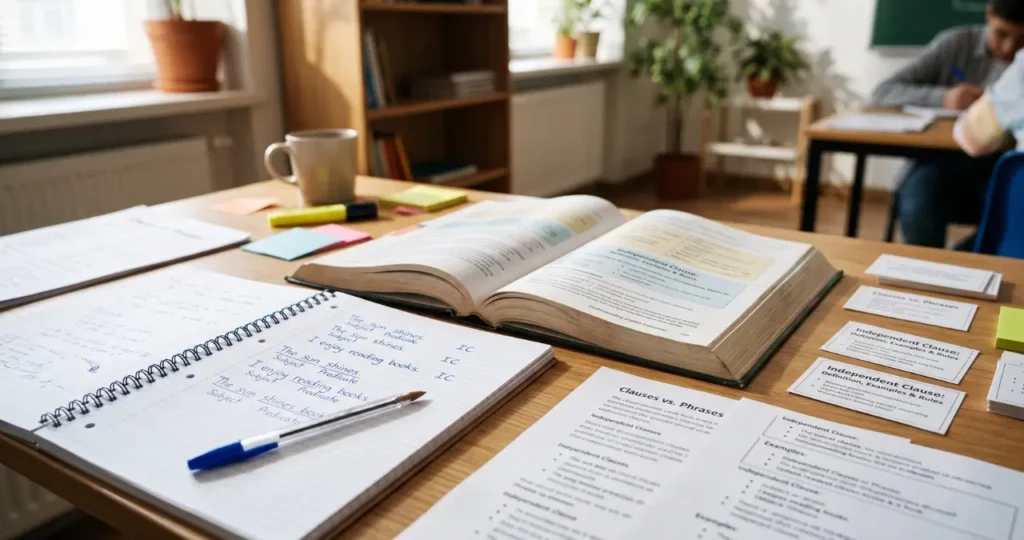

An independent clause is a group of words that contains a subject and a verb and expresses a complete thought, which means it can stand alone as its own sentence. Understanding what an independent clause is matters because most sentence-structure problems, run-ons, comma splices, and fragments, come down to mishandling one.
This guide breaks down what an independent clause looks like, how it differs from a dependent clause, and the exact rules for joining two of them without creating a grammar error.
What Is an Independent Clause?
An independent clause is a complete sentence on its own: it has a subject, a verb, and a finished thought. “The dog barked” is an independent clause because it names who did something (the dog) and what they did (barked), and it doesn’t leave the reader waiting for more information.
You can test this quickly. Read the group of words by itself. If it makes full sense without anything added before or after it, you’re looking at an independent clause. “She left early” passes that test. “Because she left early” does not, since it trails off and needs something more to complete the idea.
Independent clauses are the basic building block of English sentences. Every grammatically complete sentence contains at least one, and many sentences contain two or more joined together.
Independent Clause vs. Dependent Clause: What’s the Difference?
An independent clause can stand alone as a sentence, while a dependent clause cannot, even though it also has a subject and a verb. The difference usually comes down to one small word at the front: a subordinating conjunction like “because,” “although,” “when,” “if,” or “since.”
Compare these two:
- Independent: “I finished the report.”
- Dependent: “Because I finished the report.”
Both contain a subject (I) and a verb (finished). Only the first one works as a standalone sentence. Adding “because” turns a complete thought into an incomplete one that’s now waiting for a second clause to finish the idea, as in “Because I finished the report, I left early.”
This distinction trips up a lot of writers precisely because dependent clauses look grammatically similar to independent ones at a glance. The subordinating word is the real signal to watch for, not just whether there’s a subject and verb present.
Independent Clause Examples in Simple Sentences
Independent clauses show up constantly in everyday writing, usually as short, direct statements. Here are several clear examples:
- “Rain fell all afternoon.”
- “The meeting starts at nine.”
- “He forgot his keys.”
- “We should leave now.”
- “The results were surprising.”
Each one has a clear subject and verb, and each finishes its thought without needing anything else attached. Notice that length doesn’t matter here. “Rain fell all afternoon” is just as independent as a longer sentence like “The research team published their findings in a peer-reviewed journal last month,” because both meet the same two-part test: subject, verb, complete idea.
How to Combine Two Independent Clauses Correctly
Two independent clauses can be joined in exactly three grammatically correct ways: with a comma and a coordinating conjunction, with a semicolon, or by separating them into two full sentences with a period. Getting this wrong is the single most common source of run-on sentences and comma splices in everyday writing.
Using a Coordinating Conjunction
A comma followed by a coordinating conjunction, and, but, or, nor, for, so, yet, correctly joins two independent clauses. These seven words are sometimes remembered by the acronym FANBOYS.
Example: “I wanted to go for a run, but it started raining.” Both halves work as standalone sentences on their own, and the comma-plus-conjunction combination links them smoothly.
Using a Semicolon
A semicolon can join two independent clauses directly, without a conjunction, when the two ideas are closely related. Example: “The store closed early; nobody had expected the storm to hit so fast.”
This only works between two full independent clauses. Using a semicolon before a dependent clause or a sentence fragment is a common misuse worth watching for.
Using a Period
Simply ending one sentence and starting a new one is always a safe, correct option. “The store closed early. Nobody had expected the storm to hit so fast.” This version says the same thing as the semicolon example above, just with a slightly more deliberate pause between the two ideas.
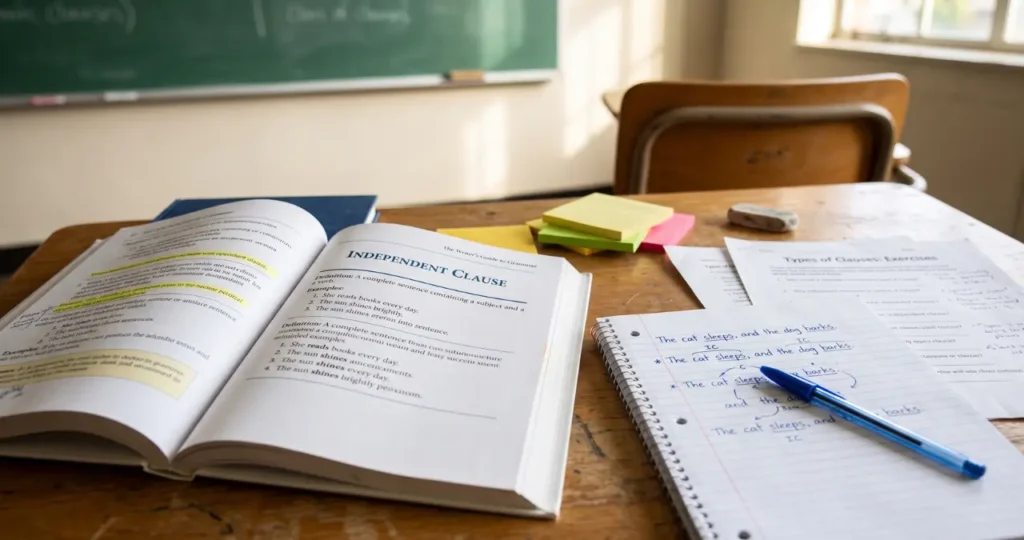
Common Independent Clause Mistakes
The two most common independent clause errors are the run-on sentence and the comma splice, both of which happen when two complete thoughts get jammed together without proper punctuation. Recognizing these patterns is often the fastest way to clean up messy writing.
A run-on sentence joins two independent clauses with no punctuation at all: “I finished the report I sent it to my manager.” A comma splice makes almost the same mistake but uses a lone comma instead of a proper connector: “I finished the report, I sent it to my manager.” Both are grammatically incorrect for the same underlying reason, two independent clauses need more than just a comma to connect them.
The fix is always one of the three methods above: add a coordinating conjunction after the comma, swap the comma for a semicolon, or split the clauses into two separate sentences.
Independent Clause Use in Compound and Complex Sentences
An independent clause forms the backbone of both compound and complex sentences, just combined differently depending on the sentence type. A compound sentence joins two or more independent clauses together, while a complex sentence pairs one independent clause with at least one dependent clause.
Compound sentence example: “She studied all night, and she passed the exam.” Both halves could stand alone, and they’re joined as equals.
Complex sentence example: “She passed the exam because she studied all night.” Here, “she passed the exam” is the independent clause, while “because she studied all night” depends on it to make full sense.
Understanding this distinction helps explain why some sentences need a comma before the conjunction and others don’t. In a complex sentence, when the dependent clause comes first, it’s typically followed by a comma: “Because she studied all night, she passed the exam.” When the independent clause comes first, that comma usually disappears.
Quick Test: How to Identify an Independent Clause in Your Own Writing
The fastest way to check whether a group of words is an independent clause is to isolate it and read it completely on its own. If it makes full sense standing by itself, with nothing added before or after, it’s independent.
Try this with your own writing. Take any sentence you’ve written and look at each clause separately. Does “he left the office early” work alone? Yes, that’s independent. Does “although he left the office early” work alone? No, it needs a second part to feel finished, so that’s dependent.
This simple isolation test catches most sentence-structure problems before they turn into run-ons, fragments, or comma splices, which makes it one of the more genuinely useful editing habits a writer can build.
FAQ
What is an independent clause in simple terms?
An independent clause is a group of words with a subject and a verb that expresses a complete thought and can stand alone as its own sentence.
What’s the difference between an independent clause and a dependent clause?
An independent clause can stand alone as a complete sentence, while a dependent clause cannot, even though it also has a subject and a verb, because it starts with a word like “because,” “although,” or “when” that leaves the thought unfinished.
Can an independent clause be a full sentence by itself?
Yes. Any independent clause is, by definition, a complete sentence on its own, since it already contains a subject, a verb, and a finished thought.
How many independent clauses can one sentence have?
A sentence can contain two or more independent clauses, as long as they’re joined correctly with a coordinating conjunction, a semicolon, or split by a period.
What happens if you join two independent clauses with just a comma?
That creates a comma splice, a grammatical error. Fix it by adding a coordinating conjunction after the comma, replacing the comma with a semicolon, or splitting the clauses into two sentences.
Can a semicolon connect an independent clause and a dependent clause?
No. A semicolon should only join two independent clauses. Using it before a dependent clause is a common punctuation mistake.
Is “although it was raining” an independent clause?
No. It has a subject and a verb, but the word “although” makes it dependent, since the thought feels unfinished without an additional clause to complete it.
What are the seven coordinating conjunctions used to join independent clauses?
They are and, but, or, nor, for, so, and yet, often remembered with the acronym FANBOYS.
What’s the difference between a compound sentence and a complex sentence?
A compound sentence joins two or more independent clauses of equal weight, while a complex sentence combines one independent clause with at least one dependent clause.
How do I quickly check if a clause is independent?
Isolate the clause and read it completely on its own. If it makes full sense without anything added before or after it, it’s an independent clause.