

Preparing for job interview questions 2026 means more than memorizing polished answers. Employers commonly use interviews to assess your experience, skills, motivation, problem-solving ability, communication style, and fit for the role.
The good news is that most interviews follow recognizable patterns. You can prepare effectively by understanding the question behind the question, building a few strong examples, and practicing concise answers rather than memorizing a script.
This guide covers the most common job interview questions 2026, sample answer approaches, behavioral questions, salary discussions, questions for fresh graduates, and smart questions you can ask at the end.
What Are the Most Common Job Interview Questions in 2026?
The most common interview questions still focus on your background, motivation, strengths, weaknesses, experience, career goals, and suitability for the position. Current interview guides from Indeed and Glassdoor continue to identify questions such as “Tell me about yourself,” “Why should we hire you?” and “What are your strengths?” among frequently used questions.
Here are 15 questions worth preparing:
- Tell me about yourself.
- Why do you want this job?
- Why do you want to work for our company?
- What are your greatest strengths?
- What is your biggest weakness?
- Why should we hire you?
- What do you know about our company?
- Tell me about a challenge you faced at work.
- Describe a time you made a mistake.
- How do you handle pressure?
- Tell me about a conflict with a coworker.
- Where do you see yourself in five years?
- Why are you leaving your current job?
- What salary are you expecting?
- Do you have any questions for us?
You do not need a completely different answer for every question. Instead, prepare several real examples that demonstrate skills such as teamwork, problem-solving, leadership, adaptability, communication, and responsibility.
How to Answer Job Interview Questions 2026 Effectively
The strongest answers connect your experience directly to the employer’s needs. Instead of giving broad statements such as “I am hardworking,” explain what you did, what changed because of your work, and what you learned.
1. “Tell Me About Yourself”
This question usually works best as a short professional introduction rather than a personal biography. Start with your current situation, mention relevant experience or skills, and finish by explaining why the opportunity interests you.
Example:
“I have experience in customer service and digital marketing, where I developed strong communication and problem-solving skills. In my previous work, I handled customer questions, managed online tasks, and worked to meet deadlines. I’m now looking for a role where I can apply those skills while continuing to develop professionally.”
Keep the answer focused on information relevant to the position.
2. “Why Should We Hire You?”
A strong response combines three things: your relevant ability, evidence that you can use it, and a connection to the employer’s needs.
For example:
“You should consider me because I have the communication and organizational skills this position requires. I’m comfortable learning new systems, managing deadlines, and taking responsibility for my work. I believe I can contribute quickly while continuing to improve.”
Avoid claiming that you are “the best candidate” without evidence.
3. “What Are Your Strengths?”
Choose strengths that matter for the specific job. Communication may matter heavily in sales, attention to detail may matter in accounting, while troubleshooting may matter in technical roles.
A useful formula is:
Strength + example + relevance to the role
Instead of saying, “I’m a fast learner,” explain what you learned, how quickly you applied it, and what result followed.
4. “What Is Your Biggest Weakness?”
The best answer shows self-awareness and improvement. Avoid disguised strengths such as “I work too hard.”
For example:
“Earlier in my career, I sometimes spent too much time trying to perfect smaller details. I’ve improved by setting priorities and deadlines for each task so I can maintain quality without delaying important work.”
The goal is not to reveal a fatal weakness. It is to demonstrate that you recognize areas for development and take action.
Behavioral Job Interview Questions 2026: Use the STAR Method
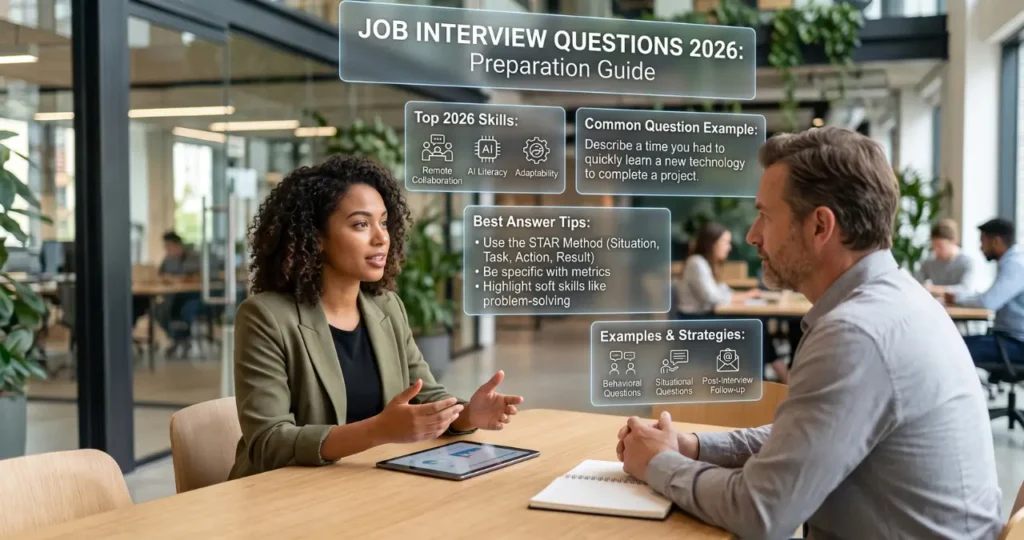
Behavioral questions ask you to describe what you actually did in a previous situation. The STAR method—Situation, Task, Action, Result—provides a simple structure for answering these questions clearly.
Typical behavioral questions include:
- Tell me about a time you solved a difficult problem.
- Describe a conflict with a coworker.
- Tell me about a time you made a mistake.
- Give me an example of when you worked under pressure.
- Describe a time you had to adapt to change.
- Tell me about a goal you achieved.
- Give me an example of when you helped a teammate.
How STAR Works
Situation: Briefly explain the circumstances.
Task: Describe your responsibility or objective.
Action: Explain specifically what you did.
Result: Describe the outcome and, where possible, quantify it.
For example, if asked about a difficult customer, do not simply say, “I stayed calm and solved the issue.” Explain what the customer needed, what steps you personally took, and what happened afterward.
A useful improvement is to include the lesson you learned when appropriate. LinkedIn notes that behavioral interviewing is designed to understand how candidates have handled real situations and the skills demonstrated through those experiences.
Job Interview Questions 2026 for Fresh Graduates
Fresh graduates can answer interview questions effectively even without extensive professional experience. Use examples from internships, university projects, volunteer work, part-time jobs, coursework, societies, or personal projects when they demonstrate relevant skills.
For example, if asked:
“Tell me about a time you worked in a team.”
You could discuss a university project where you divided responsibilities, handled a disagreement, met a deadline, or helped the team complete its work.
For:
“Why should we hire you without experience?”
Focus on transferable skills, preparation, willingness to learn, and evidence of responsibility.
A strong answer might be:
“Although I’m at the beginning of my career, I’ve developed relevant skills through academic projects and practical work. I’m comfortable learning new tools, taking feedback, and working toward deadlines. I’m looking for an opportunity where I can turn those skills into professional experience.”
Do not apologize repeatedly for being inexperienced. Show the interviewer what you can already contribute.
How to Answer Difficult Job Interview Questions
Difficult questions become easier when you understand what the interviewer is trying to assess. Questions about failure may test accountability, questions about conflict may test communication, and questions about career changes may test motivation and consistency.
“Why Did You Leave Your Last Job?”
Keep the answer professional. Avoid insulting a former employer or blaming coworkers.
You could say:
“I’m looking for an opportunity with greater responsibility and stronger alignment with the skills I want to develop.”
If you were laid off, be truthful and concise. Explain what happened without turning the interview into a long explanation of the circumstances.
“Tell Me About a Failure”
Choose a genuine but manageable example. Explain what went wrong, what you personally learned, and what you changed afterward.
A weak answer says:
“I’ve never really failed.”
A stronger answer accepts responsibility and demonstrates improvement.
“How Do You Handle Pressure?”
Give a practical example rather than simply saying you work well under pressure. Explain how you prioritize tasks, communicate deadlines, and maintain accuracy when several responsibilities compete.
Salary and Availability Questions
Salary questions require preparation because employers may ask about expectations, previous compensation, or your preferred range. Your answer should reflect the role, your experience, the market, and the overall compensation package rather than an arbitrary number.
Before the interview, research the typical pay range for the position and location. If you do not know enough to give a precise figure, you can say:
“I’m open to discussing the compensation based on the responsibilities of the role and the overall package. I’d be interested to know the range you have budgeted for the position.”
Employers may also ask whether you can relocate, travel, work specific schedules, or start on a particular date. Answer honestly. Do not promise availability you cannot maintain.
What Questions Should You Ask the Interviewer?
Asking thoughtful questions shows that you are evaluating the role as well as seeking an offer. Good questions can help you understand responsibilities, expectations, team structure, company culture, and how success will be measured.
Consider asking:
- What would success look like in the first 90 days?
- What are the biggest priorities for this position?
- How is performance measured?
- What does a typical week look like?
- Who would I work with most closely?
- What challenges is the team currently facing?
- What opportunities are available for learning and development?
- What are the next steps in the hiring process?
Avoid asking questions whose answers are clearly available on the company’s website.
How to Prepare for Job Interview Questions 2026
The most effective preparation is targeted practice, not memorizing dozens of scripts. Research the company and job description, identify the core skills required, and prepare several examples that demonstrate those skills.
Use this preparation method:
1. Study the job description.
Highlight repeated skills, responsibilities, qualifications, and tools.
2. Research the employer.
Understand what the company does, who its customers are, and what the role contributes.
3. Prepare six STAR stories.
Choose examples covering teamwork, problem-solving, failure, leadership, conflict, and achievement.
4. Practice your introduction.
Keep your “Tell me about yourself” answer concise and relevant.
5. Prepare questions for the interviewer.
Select three or four questions, then choose the most appropriate ones during the conversation.
6. Practice aloud.
Speaking answers is different from silently reading them. Practice until your responses sound natural rather than memorized.
Job Interview Questions 2026: What Makes an Answer Strong?
A strong answer is specific, relevant, concise, and supported by evidence. The biggest difference between an average response and a convincing one is often the amount of useful detail rather than the complexity of the language.
Compare these two answers:
Weak:
“I’m good at teamwork and communication.”
Stronger:
“During a project with four teammates, I coordinated our deadlines and created a simple task tracker. When one task fell behind, I helped redistribute the workload so we could submit the project on time.”
The second answer gives the interviewer something concrete to evaluate.
This is particularly important for behavioral questions because interviewers are looking for evidence of how you approach real workplace situations, not just a list of personal qualities.
Common Interview Mistakes to Avoid
Avoiding a few predictable mistakes can improve an otherwise strong interview. The most common problems include giving overly long answers, failing to research the company, speaking negatively about former employers, and providing claims without examples.
Watch for these mistakes:
- Memorizing answers word for word.
- Giving one-word or extremely short responses.
- Repeating your resume instead of explaining your impact.
- Criticizing a previous employer or coworker.
- Making achievements sound larger than they were.
- Avoiding responsibility for mistakes.
- Forgetting to connect your experience to the job.
- Asking only about salary, holidays, or benefits.
- Having no questions prepared for the interviewer.
- Speaking so quickly that your answer becomes difficult to follow.
If you do not know an answer, do not invent one. Explain what you know, acknowledge the gap, and describe how you would find the correct information.
FAQ
What are the top job interview questions in 2026?
Common questions include “Tell me about yourself,” “Why do you want this job?”, “What are your strengths and weaknesses?”, “Why should we hire you?”, and behavioral questions about teamwork, conflict, challenges, and mistakes.
How should I answer “Tell me about yourself” in an interview?
Give a concise professional summary covering your current background, relevant experience or skills, and why you are interested in the position. Avoid unrelated personal history.
What is the STAR method for interviews?
STAR stands for Situation, Task, Action, and Result. It helps candidates structure answers to behavioral questions around a specific workplace or project experience.
How many interview questions should I prepare for?
Rather than memorizing answers to a huge list, prepare for the major categories: background, motivation, strengths, weaknesses, experience, behavioral situations, salary, career goals, and role-specific questions.
What should a fresh graduate say when asked about experience?
Use relevant examples from internships, university projects, volunteer work, part-time employment, coursework, or personal projects. Focus on transferable skills and what you achieved.
What is a good answer to “Why should we hire you?”
Connect your strongest relevant skills to the employer’s needs and support your claims with a specific example. Avoid simply describing yourself as hardworking or passionate.
How should I answer questions about my weaknesses?
Choose a genuine but manageable weakness, explain how it affected your work, and describe the specific steps you have taken to improve.
What questions should I ask at the end of an interview?
Ask about success in the role, current priorities, team structure, performance measurement, challenges, development opportunities, and the next stage of the hiring process.
How can I prepare for job interview questions 2026 in one day?
Focus on the job description, research the company, prepare your introduction, create five or six STAR examples, practice common questions aloud, and prepare several questions for the interviewer.
Should I memorize my interview answers?
No. Prepare key points and examples instead. Memorized scripts can sound unnatural, while structured notes help you answer naturally and adapt when the interviewer asks a follow-up question.