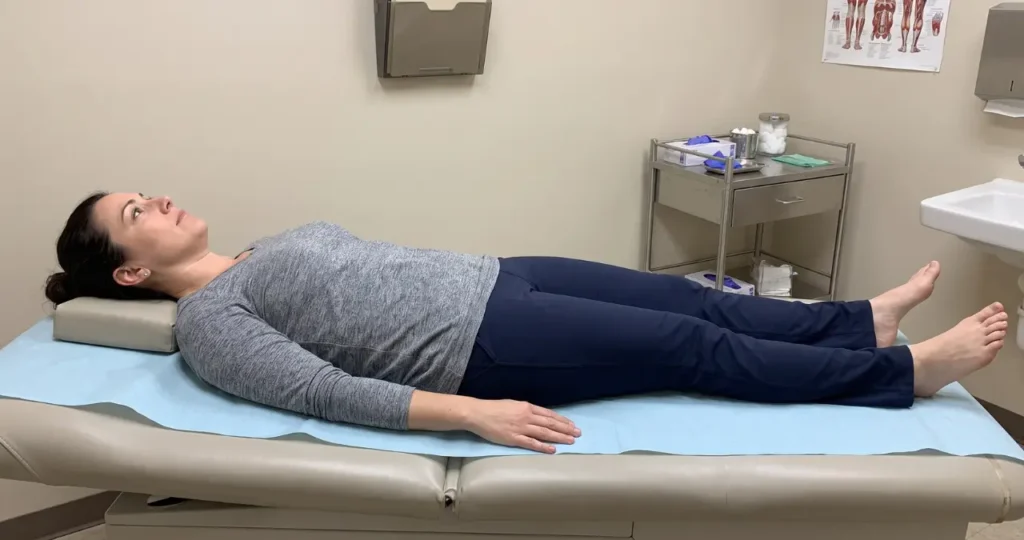

The supine position means lying flat on your back with your face and the front of your body facing upward. It is one of the most common body positions used in healthcare, physical examinations, surgery, exercise, and everyday rest.
Although the position looks simple, the way the head, neck, arms, hips, legs, and feet are supported can affect comfort and safety. It is also not ideal for everyone or every situation, particularly during late pregnancy or for some people with breathing problems.
What Is the Supine Position?
The supine position is a body posture in which a person lies on their back, generally with the body facing upward. In a clinical setting, the head, neck, and spine are commonly kept in a neutral alignment.
The word supine describes orientation rather than a specific medical treatment. A person can be completely flat or have their head or upper body slightly elevated while still being described as supine, depending on the clinical context.
For example, a patient lying face-up on an examination table is supine. Someone lying face-down is in the prone position, while someone lying on either side is in a lateral position.
Supine vs. Prone Position
The main difference is which side of the body faces the surface. In the supine position, the back contacts the bed or table and the face points upward; in the prone position, the chest and abdomen face downward.
| Position | Body orientation | Common description |
|---|---|---|
| Supine | Back down | Lying face-up |
| Prone | Front down | Lying face-down |
| Lateral | Side down | Lying on one side |
| Fowler’s | Back supported with upper body elevated | Semi-upright |
This distinction matters because changing body orientation can alter pressure distribution, breathing mechanics, access to body areas, and clinical care requirements.
Why Is the Supine Position Used?
The supine position is widely used because it provides convenient access to the front of the body and allows healthcare professionals to examine or treat many anatomical areas. It is also a common position for surgery and patient repositioning.
Healthcare professionals may use it during:
- Physical examinations
- Certain surgical procedures
- Imaging and diagnostic procedures
- Patient transfers
- Bedside nursing care
- Some rehabilitation exercises
- Certain procedures involving the chest, abdomen, pelvis, or limbs
The exact positioning depends on the procedure and the patient’s medical condition. Factors such as age, body size, weight, medical history, and respiratory or circulatory problems can influence which position is appropriate.
For patients who cannot move easily, careful positioning also helps maintain body alignment and reduce avoidable pressure or nerve-related problems.
How to Position Someone Supine Safely
A safe supine position keeps the body supported and aligned rather than simply placing someone flat on a mattress. Pillows, wedges, blankets, or other positioning aids may be used when appropriate.
A basic setup generally involves:
- Place the person on their back on a stable surface.
- Keep the head and neck comfortably aligned.
- Support the head with a suitable pillow if needed.
- Keep the arms in a comfortable, supported position.
- Maintain natural alignment of the hips and legs.
- Check that the feet and heels are not exposed to unnecessary pressure.
- Reassess comfort and alignment regularly, particularly if the person has limited mobility.
For people who spend extended periods in bed, positioning should not be treated as a one-time task. Regular repositioning can help maintain alignment and reduce pressure-related complications.
Should You Put a Pillow Under the Knees?
A pillow under the knees can make lying on the back more comfortable for some people by slightly changing the position of the legs and reducing strain. However, there is no universal pillow arrangement that works for everyone.
For patients with limited mobility, healthcare professionals may use specific supports based on individual needs rather than relying on a standard setup.
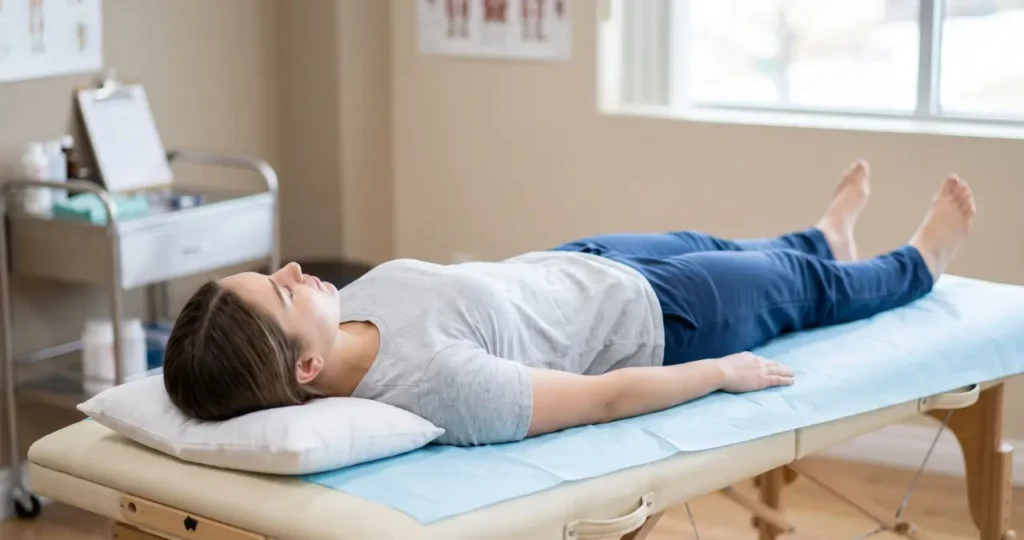
What Are the Benefits of the Supine Position?
The supine position offers several practical benefits, especially when healthcare professionals need access to the front of the body. It can also provide a stable starting position for examinations, procedures, and certain exercises.
Key advantages include:
- Easy access to the front of the body
- Straightforward observation of body alignment
- Useful positioning for many medical procedures
- Convenient position for some examinations
- Easy access for patient transfers
- Compatibility with certain physical therapy and exercise movements
It can also make it easier to stabilize or support individual body parts with pillows and positioning devices.
However, “common” does not mean “best for everyone.” The appropriate position depends on what the person is doing, their medical condition, and how long they remain there.
What Are the Risks of the Supine Position?
The supine position can create problems when someone remains in it for too long or when the position does not suit their medical condition. Potential concerns include pressure on vulnerable areas, breathing limitations in certain patients, and circulatory effects in specific situations.
People with limited mobility are particularly important to monitor because prolonged pressure can contribute to pressure injuries. Proper repositioning and supportive devices can help reduce these risks.
The position can also affect breathing mechanics in some critically ill patients. A clinical guideline notes that lying completely flat on the back can reduce functional residual capacity and affect diaphragm movement, with effects becoming more important in certain critically ill or anesthetized patients.
That does not mean lying on your back is inherently dangerous for healthy people. The risk depends heavily on the individual and the circumstances.
Supine Position During Pregnancy
The supine position requires special consideration during later pregnancy, particularly when sleeping. NHS guidance recommends going to sleep on either side after 28 weeks because going to sleep on the back has been associated with a higher risk of stillbirth.
The reason is thought to involve changes in blood flow and oxygen delivery when the pregnant uterus presses on major blood vessels. Lying on the back can also cause some pregnant people to feel faint or dizzy.
Importantly, NHS guidance says that if you wake up on your back, you should not panic. Simply turn onto your side and go back to sleep.
This advice concerns going to sleep, including nighttime sleep and naps. Individual medical circumstances can differ, so people with pregnancy complications should follow their maternity team’s advice.
Is the Supine Position Good for Sleeping?
For many healthy adults, sleeping on the back can be comfortable, but it is not automatically the best sleeping position for everyone. People with certain sleep-related breathing problems may experience more symptoms when sleeping supine.
Sleep medicine guidance recognizes that obstructive sleep apnea can be position-dependent in some patients, with breathing disturbances potentially differing between supine and non-supine sleep.
If someone regularly snores heavily, wakes up choking or gasping, experiences witnessed breathing pauses, or remains excessively sleepy during the day, changing sleeping position alone should not replace medical evaluation.
A sleep specialist can determine whether symptoms indicate sleep apnea or another sleep disorder.
Supine Position in Nursing and Patient Care
The supine position is a fundamental patient-care position because nurses may use it during repositioning, transfers, examinations, and other routine care. Correct technique matters particularly when the patient has limited mobility.
Nursing guidance emphasizes maintaining body alignment and using supportive devices when appropriate. For example, pillows can provide comfort or help prevent problems such as foot drop.
For patients at risk of heel pressure injuries, nursing guidance may recommend positioning the calves so the heels are lifted away from direct mattress pressure.
The important principle is not simply “put the patient on their back.” The patient’s condition, pressure-injury risk, mobility, comfort, and treatment plan should determine how they are positioned.
Supine Position in Surgery
The supine position is one of the most commonly used surgical positions, particularly when surgeons need access to the front of the patient’s body. The head, neck, and spine are generally maintained in neutral alignment, while arm placement depends on the procedure and safety requirements.
Because patients may remain in one position during anesthesia, surgical teams must pay close attention to pressure points, nerves, circulation, and overall alignment.
This is different from ordinary lying on a bed. During surgery, positioning becomes part of patient safety and requires trained professionals and appropriate equipment.
Supine Position and Exercise
The supine position is also common in exercise, stretching, physiotherapy, and rehabilitation. Exercises such as certain abdominal movements, mobility exercises, and stretches may begin with the person lying on their back.
The advantage is stability: the floor or exercise surface supports much of the body while the person moves specific joints or muscle groups.
However, lying on the back for exercise is not appropriate in every situation. During pregnancy, for example, NHS guidance recommends avoiding exercises that involve lying on the back for more than a few minutes, particularly after 16 weeks, because the growing uterus can press on a major blood vessel and cause dizziness or low blood pressure.
Supine, Fowler’s and Lateral Positions: What’s the Difference?
The supine position keeps the person flat on their back, while Fowler’s positioning raises the upper body and lateral positioning places the person on their side. These positions serve different clinical purposes.
Supine: Face upward with the back against the supporting surface.
Fowler’s: The person remains generally on their back while the head of the bed is elevated. Semi-Fowler’s positioning typically uses a smaller elevation.
Lateral: The person lies on one side. This can help relieve pressure from the coccyx and is often used when repositioning patients.
The best position is therefore task-dependent. A position that works well for an examination may not be suitable for prolonged sleep or for a person with a particular medical condition.
When Should You Avoid or Modify the Supine Position?
You should modify or avoid prolonged flat-back positioning when it causes symptoms or conflicts with medical guidance. Pregnancy, certain respiratory or circulatory conditions, limited mobility, and pressure-injury risk can all change positioning requirements.
Seek professional advice if lying flat causes significant shortness of breath, dizziness, chest discomfort, faintness, or other concerning symptoms.
During pregnancy, follow your maternity team’s recommendations, especially after 28 weeks. If you have a condition that affects breathing, circulation, mobility, or blood pressure, a clinician can advise whether another position is safer.
FAQ
1. What does supine position mean?
The supine position means lying flat on your back with your face and front of the body facing upward. It is the opposite of the prone, or face-down, position.
2. Is supine the same as lying on your back?
Yes. In ordinary medical terminology, supine describes a person lying on their back with the body facing upward.
3. What is the difference between supine and prone?
Supine means lying face-up on the back, while prone means lying face-down on the abdomen or front of the body.
4. Is the supine position good for sleeping?
It can be comfortable for some people, but it is not ideal for everyone. People with certain sleep-related breathing problems may have worse symptoms when sleeping on their backs.
5. Can you sleep in the supine position during pregnancy?
NHS guidance recommends going to sleep on your side after 28 weeks because going to sleep on your back is associated with a higher risk of stillbirth. If you wake up on your back, turn onto your side rather than worrying.
6. Why is supine positioning used in hospitals?
It provides convenient access to the front of the body and is useful for many examinations, procedures, surgeries, transfers, and nursing tasks.
7. Is the supine position safe for everyone?
No position is universally appropriate for every patient. Medical conditions, pregnancy, mobility, pressure-injury risk, and respiratory or circulatory problems can affect positioning decisions.
8. What position is opposite to supine?
The prone position is the opposite orientation. Supine places the back against the supporting surface, while prone places the front of the body against it.
9. Can the supine position cause pressure injuries?
Prolonged positioning can contribute to pressure-related problems, particularly in people with limited mobility. Regular repositioning and appropriate support can help reduce pressure and maintain alignment.
10. What is the safest position during late pregnancy?
After 28 weeks, NHS guidance recommends going to sleep on either side rather than starting sleep on your back. If you wake up supine, simply turn onto your side and return to sleep.